
From niche concern to global imperative E-waste has become one of the world’s fastest-growing resource challenges, and the ability to recover value at scale is now critical.
Our advanced recycling technology transforms waste into a reliable source of secondary raw materials for the circular economy.
From Niche Concern to Global Imperative: Why E‑Waste Can’t Wait
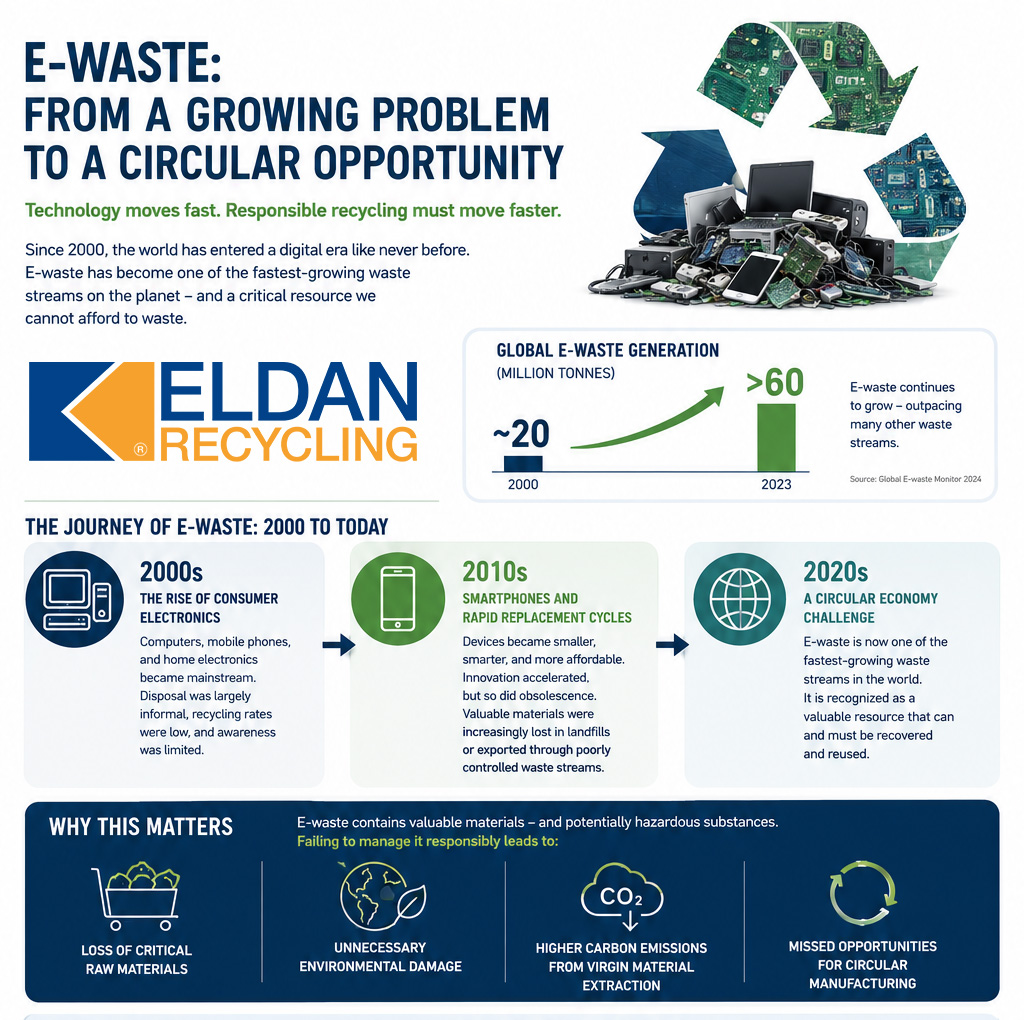
The story of e‑waste over the last 25 years mirrors the story of our digital world:
2000s: The rise of consumer electronics
Computers, mobile phones, and home electronics became mainstream. Disposal was largely informal, recycling rates were low, and awareness was limited.
2010s: Smartphones and rapid replacement cycles
Devices became smaller, smarter, and more affordable. Innovation accelerated, but so did obsolescence. Valuable materials were increasingly lost in landfills or exported through poorly controlled waste streams.
2020s: A circular economy challenge
E‑waste is now one of the fastest‑growing waste streams in the world. Governments, businesses, and consumers are recognizing that discarded electronics are not just waste — they are a resource containing metals, plastics, and components that can be recovered and reused.

Why this matters
E‑waste contains valuable materials such as copper, aluminum, gold, and high‑grade plastics. But it can also contain hazardous substances that require careful handling. Failing to process e‑waste responsibly means:
- loss of critical raw materials,
- unnecessary environmental damage,
- higher carbon emissions from virgin material extraction,
- missed opportunities for circular manufacturing.
In other words, e‑waste management is no longer only an environmental issue. It is a resource security, industrial efficiency, and sustainability issue.
The role of technology and industry
Solving the e‑waste challenge requires more than collection programs. It requires advanced processing technologies that can efficiently separate and recover materials at scale. This is where we play an important role.
For decades, Eldan Recycling has developed and supplied recycling systems that help transform complex waste streams into valuable secondary raw materials. Our solutions for electronic waste processing are designed to:
- shred and liberate components efficiently
- separate metals and plastics with high purity
- maximize material recovery
- reduce the amount of waste sent to landfill
By enabling higher recovery rates and better material quality, advanced recycling technology helps make the circular economy commercially viable not just environmentally desirable.

A broader perspective
The E‑waste challenge will continue to grow as electrification, AI infrastructure, renewable energy systems, and connected devices expand globally. But growth in technology does not have to mean growth in waste.
The next chapter is about building systems where products are designed for recovery, materials stay in circulation, and recycling infrastructure is treated as essential industrial capability.
Responsible E‑waste management is no longer optional. It is part of how we secure resources, reduce emissions, and build a more resilient economy.